top of page

NEWS

I am a description.
Click here to edit.

Sunday, December 21, 2025 - Fourth Sunday of Advent


The Rev. Morgan Walker Annable (she/her)

Pastor, Grace Lutheran Church (Wadsworth, OH)

Allied Christian


Now the birth of Jesus the Messiah took place in this way. When his mother Mary had been engaged to Joseph, but before they lived together, she was found to be pregnant from the Holy Spirit. Her husband Joseph, being a righteous man and unwilling to expose her to public disgrace, planned to divorce her quietly. But just when he had resolved to do this, an angel of the Lord appeared to him in a dream and said, “Joseph, son of David, do not be afraid to take Mary as your wife, for the child conceived in her is from the Holy Spirit. She will bear a son, and you are to name him Jesus, for he will save his people from their sins.” All this took place to fulfill what had been spoken by the Lord through the prophet: “Look, the virgin shall become pregnant and give birth to a son, and they shall name him Emmanuel, which means, ‘God is with us.”

(Matthew 1:18-23)


Our world leaves us with much to be afraid of. For the LGBTQIA+ community, those fears are often amplified. Questions like these flood the minds of Queer folks on a daily basis:

  • Am I free to be myself in a world that often shows me hate instead of love?

  • Will I face public disgrace or even violence?

  • How long, O Lord, will the suffering continue for our LGBTQIA+siblings?


Our world leaves us with much to be afraid of, and rightfully so. The injustices against LGBTQIA+ folks don’t seem to go away. The questions and worries creep their way into our minds with ample justification for our fears. Even still, the nativity story from Matthew offers us two reminders:

  1. Do not be afraid.

  2. God is with us.


These reminders are easier said than felt most of the time. How are we to let go of our fear when danger seems so close? And how are we to know that God is with us when God often feels so far away? I don’t have easy answers to these questions. And yet, in this Christmas

season, we are still reminded: Do not be afraid. God is with us.


In the midst of our fear, God is with us. In holiday gatherings with chosen family, God is with us. In the midst of injustice and violence, God is with us. In the joy of a person living into their identity as someone made in the image of God, God is with us. Even when fear creeps in, even when our hope seems lost, even when we feel like things will never change, God’s gentle voice whispers: “My beloved child, do not be afraid. I am with you.:


Reflection


What fears do you want to let go of so you can experience God’s presence more fully?


Action


Elyse Myers often says she doesn’t “get over” her fear before doing something. Instead, she just “does things scared.” So today, do one thing that scares you. Maybe you tell someone how you feel, set a boundary, or try something new. Whatever you do, know that God is with you each step of the way. In the process, you may learn more about yourself and about God’s presence in your life.


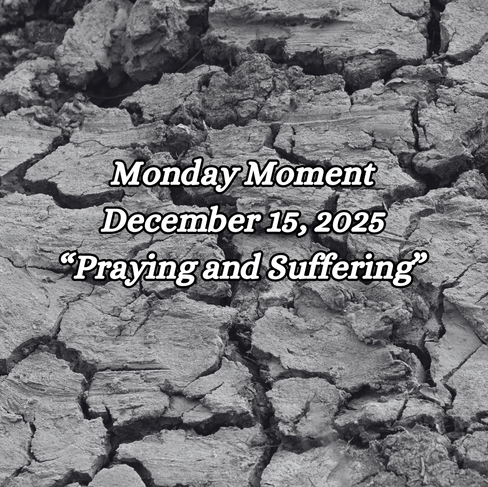
Monday, December 15, 2025


Happy Monday, my friends! I apologize that this present season has caused me to be unable to write and publish Monday Moments as regularly as in the past, but I’m happy to be able to write something for you today. At Blue Ocean Faith Columbus, the church I pastor, we’re reading Living Buddha, Living Christ by the Zen Buddhist master Thich Nhat Hahn. As the title implies, Nhat Hahn writes about the similarities and differences between Buddhism and Christianity which he senses having studied Christianity and interacted with Christians including both French Roman Catholics and American Progressive Protestants (among them Martin Luther King, Jr. and Bayard Rustin).


Though his project is oriented to comparing the Buddha and Jesus, he also spends time discussing Buddhist mindfulness and community consciousness and the Holy Spirit. Speaking to mindfulness and the Spirit, he addresses prayer: “Many people pray to God because they want God to fulfill some of their needs.”[1] Very true, we do almost always pray because we want a need fulfilled, from our favorite team to win a game to the recovery of a loved one who is close to death. We also pray in thanksgiving and because something routine, but nevertheless important has happened. My TFAM siblings often talk about getting out of bed and thanking God for waking them up another day. I admit that is not part of my normal prayer routine.


Nhat Hahn goes on to address praying for our enemies, a practice preached by Jesus, but by no means unique to the Christian tradition. He says, “When you look deeply into your anger, you will see that the person you call your enemy is also suffering. As soon as you see that, the capacity of accepting and having compassion for him [sic] is there…The idea of ‘enemy’ vanishes and is replaced by the notion of someone who is suffering and needs your compassion.”[2] A perhaps overused phrase that is nevertheless true says that “hurt people hurt people.” When we looked closely at the people who hurt us, who commit evil against us and against others, we often find a person who is themselves deeply hurt. It should be obvious, though, that just because a person is hurt and suffering, the evil they do is not excused. We can be hurt and still be accountable to our actions. We can be hurt and be forgiven, but forgiveness is not immunity from the consequences of our actions.


Praying for our enemies and recognizing their suffering no less makes them immune to consequences as it relieves us of our call to practice the work of justice. Nhat Hahn ends his section on prayer, enemies, and suffering with a reminder that prayer necessarily involves action: “To a Buddhist, praying without practicing is not real prayer.”[3] So too for a Christian.


Do you recognize how the people you call “enemies” are also suffering? How can you merge prayers for your enemies and holding them accountable through your actions?


Let us pray: God, we pray for our enemies not only because Jesus commanded us to, but because we know they too are suffering. We know that their actions are a product of their insecurities, their attachments to ideas and paradigms which aren’t life giving. Yet, we still do not excuse their actions. Help us to walk the path of prayer and forgiveness which still participates in the work of justice, and which never negates accountability. Grant us the grace which Jesus had as he prayed for those people who participated in his death. We ask this in the name of Jesus, our savior and liberator. Amen.


Blessings on your weeks, my friends! Please let me know if there is anything I can do for you.


Faithfully,


Ben +


[1] Thich Nhat Hahn, Living Buddha, Living Christ, (Riverhead Books, 2007), 78.

[2] Thich Nhat Hahn, 2007, 78-79.

[3] Thich Nhat Hahn, 2007, 79.


Sunday, December 14, 2025 - Third Sunday of Advent


The Rev. Julia Joyce-Miesse (she/her)

Rector, St. Luke Episcopal Church

Queer Christian


Do not worry about anything, but in everything by prayer and supplication with thanksgiving, let your requests be made known to God.

(Philippians 4:6)


I was recently in a local coffee shop and overheard a conversation of someone coming out to a friend. The friend sat quietly, listened to the quivering voice bearing their soul, and responded, “I love you, and I will pray for you – not because God doesn’t love you too, but because this world can be cruel, and your life might not be easy…prayer helps.” I was reminded of Celie’s letters to God as a way to express herself in Alice Walker’s book, The Color Purple. Celie spent a life being mistreated, name-called, and othered by people. Celie’s narrative was not perfectly written nor edited for content; it was her heart to God. Through Walker’s book, we are allowed to join Celie in her healing journey and realization of herself as beloved.


I read Celie’s letters as journaled prayers. We do not need the “right words” to talk with God. And, where I believe that God knows our thoughts before we do, I think it is helpful in our humanity to write down the words, emotions, and concerns of our hearts. It is often in breaking down the vulnerable wall of thought to penned manuscripts we find answers and healing. Might it be in this vulnerable space that the Holy Spirit moves within us?


Rejoice this day that we are Beloved! We are made in the image of God – good, Holy, beautiful, worthy, and enough – just like you are – right now! Repeat that to yourself. You are BELOVED!


Reflection


How might you discover the beautiful image of God that lives within you?


Mary Church Terrell taught that we should “lift as we climb.” As a member of the LGBTQIA2S+ community, how might you help someone else find their belovedness?


Action


Make time daily to write a letter to God as part of your journey to discover your beautiful self!


LOVEboldly exists to create spaces where LGBTQIA+ people can flourish in Christianity. Though oriented to Christianity, we envision a world where all Queer people of faith can be safe, belong, and flourish both within and beyond their faith traditions.   

SWC_edited.jpg

LOVEboldly is a Partner-in-Residence with Stonewall Columbus.

LOVEboldly is a Member of Plexus, the LGBT Chamber of Commerce.

CONTACT >

30 E College Ave.

Westerville, OH 43081

(614) 918-8109

admin@loveboldly.net

EIN: 81-1869501

15th Anniversary Logo (1).png

© 2025 by LOVEboldly, Inc. - a 501(c)(3) not-for-profit organization

bottom of page